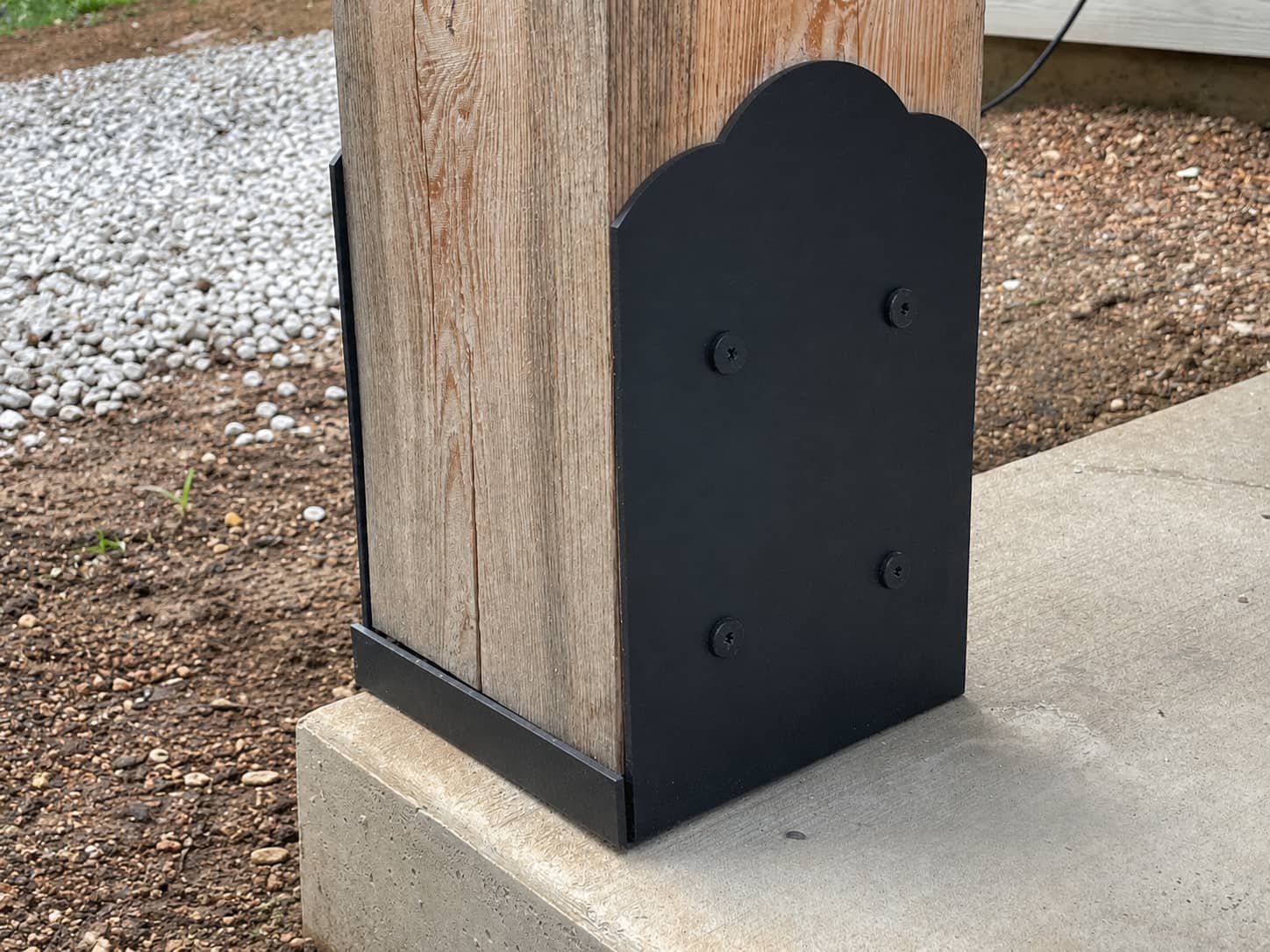
Look at the bottom of that post.
Most people never do. They walk under a timber pavilion and look up at the roof, the ceiling boards, the beam connections. The post base sits six inches off the ground and gets ignored.
That is a mistake, because the post base is doing more structural work than almost anything else on the structure, and it is one of the few details that determines whether your pavilion is still solid in twenty years or showing rot at the base in ten.
What You Are Looking At
The photo above shows a Woodland Construction post base installed on a finished concrete pier. The base wraps all four sides of the timber post with black powder-coated steel panels, fastened directly to the post face with structural screws. The base plate sits flat on the concrete surface and the post sits inside it, elevated slightly above the concrete.
A few things worth noticing:
The scalloped arch at the top of each side panel is not decorative accident. It is a deliberate design detail that gives the base a finished, architectural look at the transition point between hardware and timber. It reads as intentional rather than utilitarian.
The base plate extends past the post face on all sides. That overhang is where the anchor bolts pass through into the concrete below, tying the entire assembly to the footing. The post is not just resting on the concrete. It is anchored to it.
The gap between the bottom of the post and the top of the concrete is small but important. That clearance keeps the end grain of the post out of contact with the slab surface, which is where moisture collects and where rot begins.
Why the Base of the Post Is the Most Vulnerable Point
Wood fails from the bottom up.
End grain, the cross-section of wood exposed at the cut end of a timber, absorbs moisture faster than any other surface. Put that end grain in direct contact with concrete and you have created a moisture trap. Rain sheeting off the roof lands near the posts. The concrete surface holds water longer than the surrounding grade. The end grain drinks it in, stays wet, and begins to break down.
A post sitting directly on concrete without a proper base will show rot at the ground line in five to ten years depending on climate and drainage conditions. The rest of the post can be perfectly sound and the structure still becomes a problem because the rot is at the load-bearing point.
The post base solves this by doing two things simultaneously: it anchors the post mechanically so it cannot shift or lift, and it holds the wood off the concrete surface so moisture has somewhere to go other than into the end grain.
What the Steel Is Actually Doing
The post base transfers load in both directions.
Downward load, the weight of the roof, the beams, the snow load in winter, travels through the post into the base plate and from there into the concrete footing below. The base distributes that load across the footing surface rather than concentrating it at the end grain of the post.
Uplift load, the force of wind trying to lift the roof structure, travels back up through the base in reverse. The anchor bolts resist that uplift by holding the base plate against the concrete. Without proper anchoring, a strong wind event creates real risk of structural movement even on a heavy timber structure.
Lateral load, the force of wind pushing against the side of the pavilion, is resisted partly by the knee braces and partly by the post base itself. A base that wraps all four sides of the post and fastens to the concrete on multiple bolt lines handles lateral forces far better than a minimal bracket that only contacts two faces.
The Woodland post base wraps all four sides and fastens through a base plate to the concrete below. That full-perimeter engagement is what you want for a permanent outdoor structure.
The Finish Matters as Much as the Steel
Outdoor hardware fails at the finish before it fails at the metal.
A post base that uses standard galvanized coating will resist corrosion adequately but will develop surface rust and staining within a few seasons, especially in humid climates or anywhere that road salt is used near the structure. That rust transfers to the wood and stains the base of the post in a way that is difficult to remedy without removing the hardware.
Powder coat is the correct finish for architectural outdoor hardware. The coating bonds to the steel at a molecular level rather than sitting on top of it, which means it resists chipping, cracking, and moisture penetration in a way that paint and standard galvanizing do not. Matte black powder coat in particular holds color and finish better than lighter tones because it does not show UV fading or chalking the way lighter colors can.
Every Woodland post base ships with a matte black powder coat finish, matched to the connector hardware used throughout the rest of the structure. The base of the post and the top of the post read as part of the same design system.
A Note on Concrete Pier vs Slab Installation
The photo above shows a post base on a concrete pier, a raised footing that lifts the base off grade level. This is one of two common installation approaches.
On a pier foundation, each post sits on its own individual footing, typically eight to twelve inches above grade. This keeps the base hardware well above the drainage plane and makes the post base particularly visible as an architectural element.
On a slab foundation, the post base anchors into the slab surface at grade level. The base plate sits flush with the slab and the post rises from there. Slab installations require anchor bolts to be set during the pour or epoxied in after, and the base plate sits lower relative to the surrounding grade, which means drainage away from the base matters more.
Both approaches work well. The right choice depends on your site conditions, local frost depth, and whether you are pouring new concrete or working with an existing slab.
It Is the First Thing That Touches the Ground and the Last Thing That Should Fail
The post base is not a finishing touch. It is a foundational component in the most literal sense of the word.
Getting it right means your pavilion stands solid for the full life of the structure. Getting it wrong means you are addressing rot and instability at the base of your posts years before anything else on the structure shows its age.
The hardware in these photos is what right looks like.