If you have ever looked closely at a timber frame structure, you have probably seen two very different ways that beams connect to posts.
The traditional method is mortise and tenon: one timber is carved into a peg, another is hollowed out to receive it, and the two pieces lock together through the wood itself. It is the joinery method that built barns and cathedrals for centuries.
The modern method is square cut joinery with engineered metal connectors: beams are cut clean and flat, then fastened to posts using precision steel hardware that ties the connection together from the outside.
Most buyers assume mortise and tenon is automatically superior because it is older and more traditional. That assumption is worth examining.
What Square Cut Joinery Actually Is
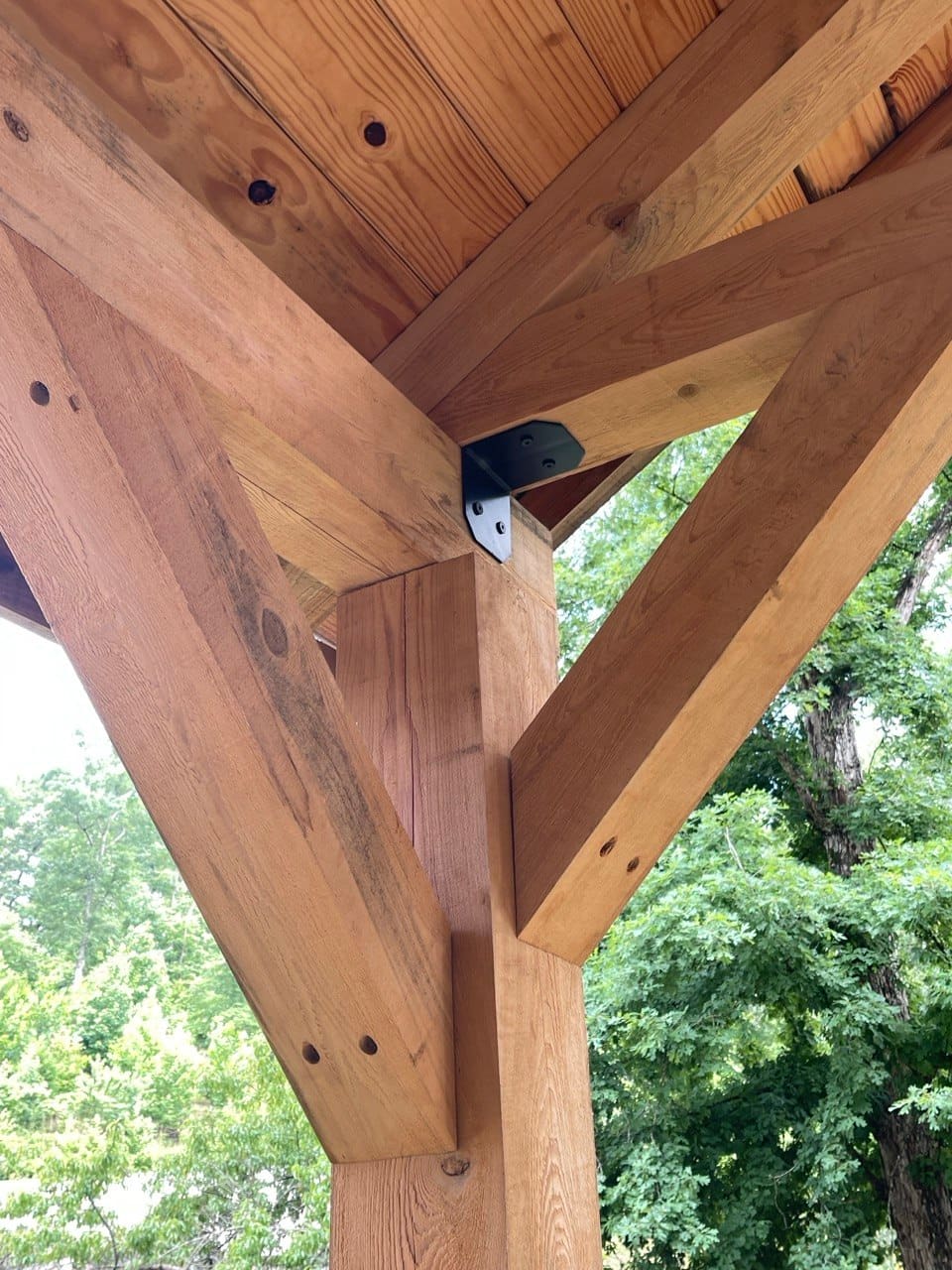
Square cut joinery, sometimes called straight cut joinery, means exactly what it sounds like. Every timber member is cut to a clean, flat end. Posts, beams, rafters, and knee braces all terminate in flat cuts rather than carved profiles.
Where the timbers meet, the connection is made with engineered steel plate connectors, black powder-coated hardware that fastens through the face of each timber using structural bolts or screws. The metal ties the assembly together and transfers load across the joint.
What you see in the photos above is a real-world example of this system. Heavy timber posts support beams and knee braces that come together at a single connection point, with a clean black steel plate sitting at the intersection. The wood grain is uninterrupted. The cuts are precise. The hardware is visible but intentional, a design element rather than something to hide.
The Case Against Mortise and Tenon for Kit Pavilions
Mortise and tenon joinery is genuinely impressive craftsmanship. It is also labor-intensive, precision-dependent, and expensive in ways that do not always serve the buyer well.
Here is why.
It requires extensive hand or machine cutting at the mill. Every joint must be individually fit. A single miscut means a piece must be remade. In a large pavilion with dozens of connection points, this adds significant time and cost to production.
It is sensitive to wood movement. Timber moves seasonally as it gains and loses moisture. Mortise and tenon joints that were tight at the mill can develop gaps, creak, or even loosen over time as the wood expands and contracts. This is not a failure of craftsmanship, it is physics. But it is a real consideration.
It is difficult to inspect. The strength of a mortise and tenon joint is inside the wood, invisible from the exterior. If something is wrong with the fit, you cannot see it until there is a problem.
It is harder to assemble in the field. Traditional mortise and tenon pavilion kits require pieces to be fitted in a specific sequence, often with tight tolerances that punish small errors in site prep or post placement.
None of this means mortise and tenon is a bad system. It means it carries trade-offs that matter for a prefabricated kit pavilion that ships across the country and gets assembled by a local crew on a real job site with real-world conditions.
Why Square Cut Joinery with Metal Connectors Works
The engineering principle behind metal plate joinery is straightforward: instead of relying on the wood geometry to transfer load, you let steel do that work.
Steel is stronger than wood in tension and shear. A properly sized and fastened connector transfers load more predictably than a hand-cut joint, and it does so consistently regardless of how the timber dries or moves over time.
Here is what this means in practice for a timber pavilion:
Consistent strength across every connection point. Every knee brace, every beam-to-post connection, every rafter seat is made with hardware engineered to a known load rating. There is no variation based on how tight a particular joint fit at the mill.
Tolerance for field conditions. Square cut pieces can be adjusted slightly during assembly without compromising the joint. The hardware fastens after placement, which gives the installation crew flexibility that traditional joinery does not.
Visible inspection. You can see every connector. You can verify every bolt is seated and every fastener is driven. The integrity of the connection is inspectable from the moment assembly is complete.
Dimensional stability over time. The steel connector holds the joint geometry regardless of wood movement. As the timber seasons, the connection does not loosen because the steel is not wood. It does not shrink, swell, or check.
Better performance in wind and seismic loading. Metal plate connectors are specifically designed and tested for uplift, lateral load, and withdrawal forces. For a permanent outdoor structure in a region with real weather, this matters.
The Aesthetic Argument: Why It Looks Right
The photos above make a point that specs alone cannot make.
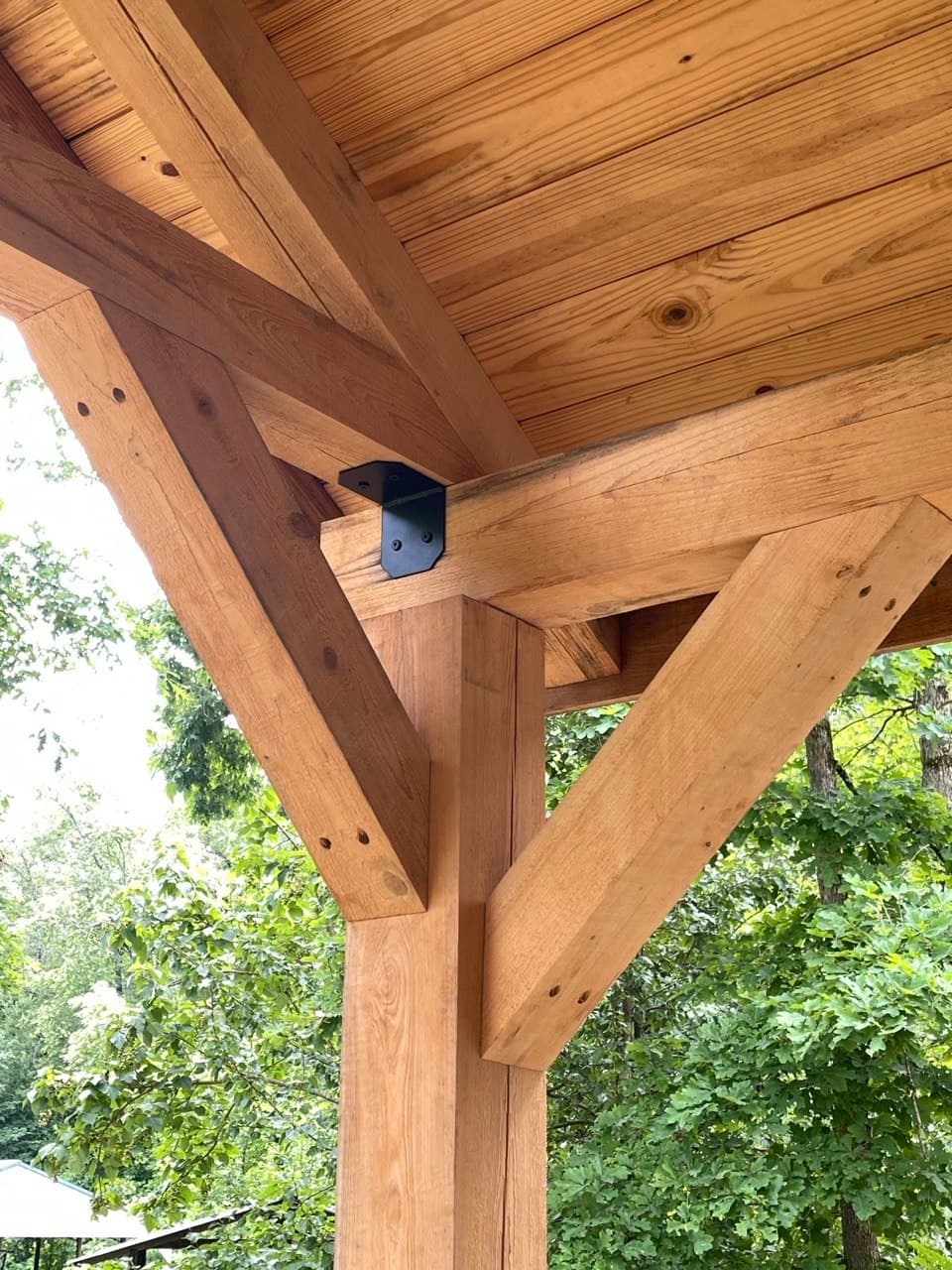
Look at the intersection of the post, the beam, and the knee brace in each image. The timbers are heavy, the grain is rich, and the cuts are clean. The black powder-coated connector sits at the apex of the joint, small enough to be subordinate to the wood, visible enough to read as intentional.
This is not hardware trying to hide. It is hardware designed to complement the structure. The contrast of matte black steel against warm cedar or cypress is a deliberate design choice, the same principle that drives the use of black iron hardware in farmhouse and craftsman interiors.
Compare this to the alternative: traditional mortise and tenon connections are often reinforced with wooden pegs that protrude from the surface, or with hidden hardware that requires pre-bored channels through the timber. Neither approach is visually cleaner than a well-placed steel connector.
Done correctly, square cut joinery with metal plating reads as modern timber frame, a style that sits comfortably between rustic and architectural, which is exactly where most pavilion buyers want to land.
What the Knee Braces Are Doing
One detail worth explaining in these photos is the knee braces.
Knee braces are the diagonal members that run from the post up to the beam at roughly 45 degrees. They are not decorative. They are structural.
A post-and-beam assembly without knee braces is a rectangle, and rectangles are not inherently rigid. Apply a lateral load, wind pushing against the side of the pavilion, and a rectangle will rack. Knee braces convert that rectangle into a series of triangles, and triangles are rigid. They resist racking by carrying the load in compression or tension along the brace rather than allowing the joint to rotate.
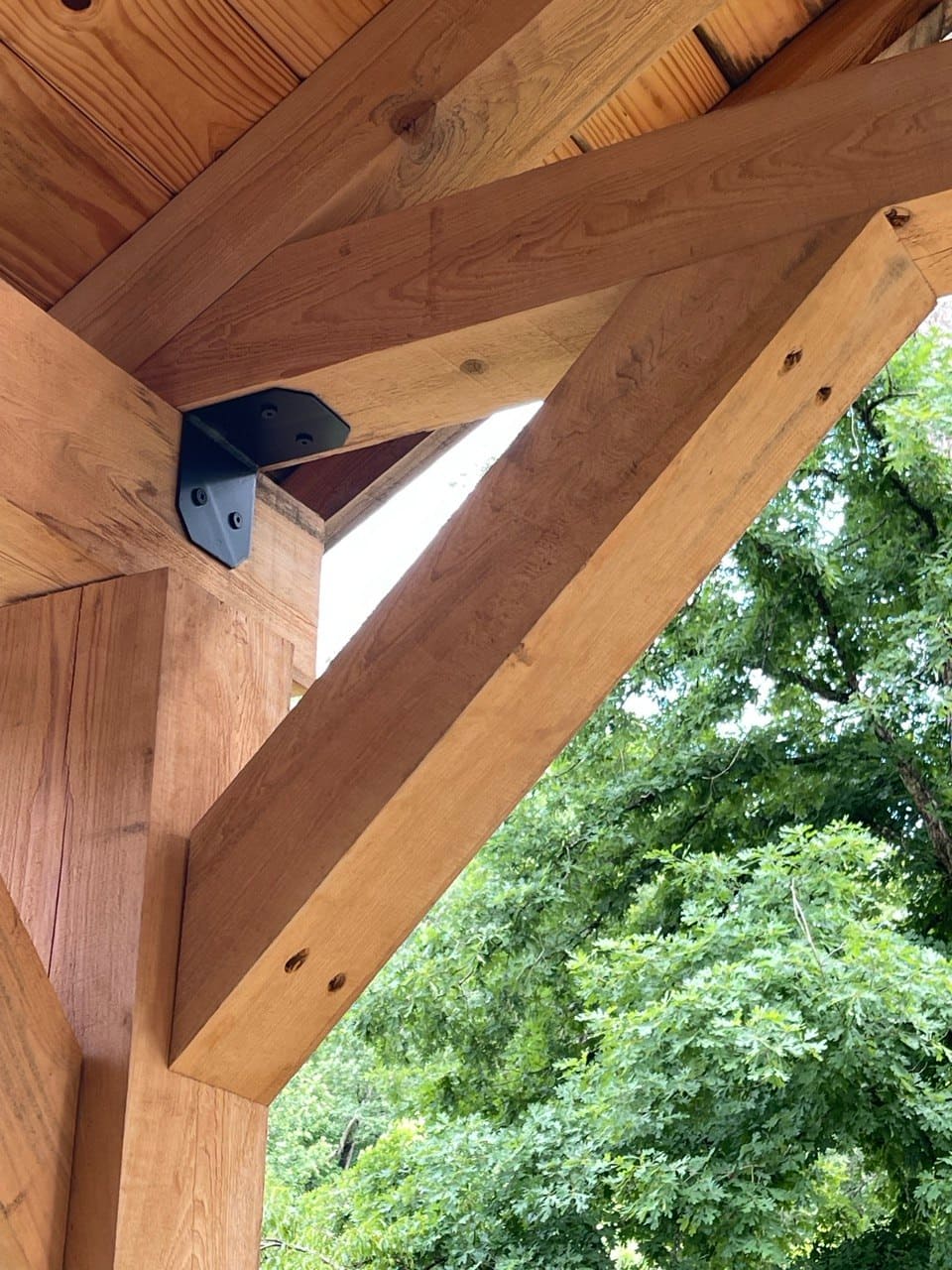
In square cut joinery, the knee brace terminates in a clean flat cut at both ends and is held in place by the same type of steel connector used at the beam-to-post joint. The load path is clear: lateral force goes into the post, the knee brace picks it up, and the steel connector keeps the geometry locked.
The result is a structure that is both visually dynamic and mechanically sound. The diagonal lines of the knee braces give the pavilion its characteristic look, and they are earning that visual prominence structurally.
How Woodland Construction Uses This System
Every Woodland Construction timber pavilion kit is built on square cut joinery with engineered steel plate connectors. This is not a cost-cutting decision. It is an engineering decision made because this system produces a more consistent, more durable, and more field-practical structure than traditional mortise and tenon construction for a kit that ships and assembles in real-world conditions.
The hardware is black powder-coated steel, matched across the structure so the connector aesthetic is consistent from the post bases at the ground to the ridge connections at the peak. The knee braces are cut and pre-fitted at the mill so the installation crew is not making structural cuts in the field.
What you see in these photos is what a Woodland pavilion looks like assembled. The joinery is not hidden. It is part of what makes the structure look the way it does.
The Bottom Line on Joinery
If you are comparing pavilion suppliers and someone is selling traditional mortise and tenon as a mark of superior quality, ask them to explain how they account for wood movement, field tolerances, and load-rated connector specifications.
If they cannot, you are paying for an aesthetic tradition rather than a structural advantage.
Square cut joinery with engineered steel connectors is how modern timber frame construction is done because it works better, assembles more reliably, and holds up longer under real conditions. The photos above show what it looks like when it is done well.
Want to See the Joinery Up Close on Your Own Build?
Woodland Construction can walk you through the connection details for any pavilion size before you order. Real specs, real hardware, and honest answers about how your structure goes together.